

Giáo án Tiếng Anh Lớp 2 - Tuần 21. Unit 10: At The Zoo - Năm học 2020-2021 - Cao Văn Hùng
 8 trang
04/08/2025
1660
8 trang
04/08/2025
1660
Bạn đang xem tài liệu "Giáo án Tiếng Anh Lớp 2 - Tuần 21. Unit 10: At The Zoo - Năm học 2020-2021 - Cao Văn Hùng", để tải tài liệu gốc về máy hãy click vào nút Download ở trên.
Tóm tắt nội dung tài liệu: Giáo án Tiếng Anh Lớp 2 - Tuần 21. Unit 10: At The Zoo - Năm học 2020-2021 - Cao Văn Hùng
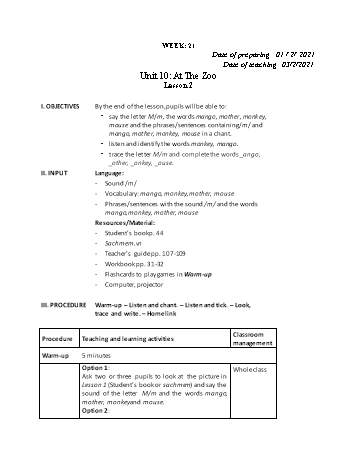
 WEEK: 21
 Date of preparing: 01 / 2/ 2021
 Date of teaching: 03/2/2021
 Unit 10: At The Zoo
 Lesson 2
I. OBJECTIVES By the end of the lesson, pupils will be able to:
 - say the letter M/m, the words mango, mother, monkey,
 mouse and the phrases/sentences containing /m/ and
 mango, mother, monkey, mouse in a chant.
 - listen and identify the words monkey, mango.
 - trace the letter M/m and complete the words _ango,
 _other, _onkey, _ouse.
II. INPUT Language:
 - Sound /m/
 - Vocabulary: mango, monkey, mother, mouse
 - Phrases/sentences with the sound /m/ and the words
 mango, monkey, mother, mouse
 Resources/Material:
 - Student’s book p. 44
 - Sachmem.vn
 - Teacher’s guide pp. 107-109
 - Workbook pp. 31-32
 - Flashcards to play games in Warm-up
 - Computer, projector
III. PROCEDURE Warm-up – Listen and chant. – Listen and tick. – Look,
 trace and write. – Homelink
 Classroom
 Procedure Teaching and learning activities
 management
 Warm-up 5 minutes
 Option 1: Whole class
 Ask two or three pupils to look at the picture in
 Lesson 1 (Student’s book or sachmem) and say the
 sound of the letter M/m and the words mango,
 mother, monkey and mouse.
 Option 2: Ask the class to play Find the odd one out again, Whole class
 using the words in Lesson 1, Unit 10 and those in
 the previous units, saying Now let us play Find the
 odd one out!
 Option 3:
 Get pupils to play What’s Missing Game, using the Whole class
 pictures and flashcards with the incomplete words
 _ango, _onkey, _other and _ouse. Pupils should
 guess the missing letters and say the words
 correctly.
3. Listen and chant. 10 minutes
 Step 1: Have pupils look at the chant, saying Look at the Whole class
 chant, please! Draw pupils’ attention to the first
 verse and explain its meaning. Ask them to pay
 attention to the letter M/m and the words
 monkey, mouse. Check comprehension.
 Step 2: Play the recording of the first verse for pupils to Whole class
 listen and to get familiarized with the rhythm,
 saying Listen to the first verse, please! Then play
 the recording for them to listen and repeat until
 they feel confident, saying Listen again and
 repeat, please!
 Step 3: Follow the same procedure with the second Whole class
 verse. Correct pronunciation, if necessary.
 Step 4: Play the recording all the way through. Ask Whole class
 pupils to listen and repeat the chant individually
 Individual
 and in chorus, saying Listen, chant and clap your
 work
 hands, please! Go around and offer help, if
 necessary.
 Step 5:
 Select some pupils to the front of the class to Individual
 chant and clap their hands. The rest of the class work
 may sing the chant and clap their hands along. If
 they have sung the chant well, praise them, Whole class
 saying Great work!
 Extension: For better pupils, cover or omit some letters/
 words in the chant and have them guess and say Individual
 all the lines aloud. For example: work
 M, m, m. Whole class
 M is for ________.
 M is for mouse.
 Monkey and _______. 4. Listen and tick. 7 minutes
 Step 1: Have pupils look at the pictures in Question 1 and Whole class
 say what they can see. Draw pupils’ attention to
 the boxes next to the letters a and b. Check
 comprehension. Invite some pupils to point to the
 pictures in Question 1 and say the words in front
 of the class. Say Point to the pictures and say the
 words, please! E.g. 1a: a monkey, 1b: a mouse.
 Step 2: Play the recording of the first sentence for pupils Individual
 to listen, saying Now listen, please! Ask pupils work
 what they have heard and ticked, saying What did
 you hear? Did you hear “There’s a monkey” or
 “There’s a mouse”? Yes, it said “There’s a
 monkey”. You tick the box a. If some pupils say
 “There’s a mouse”, let them listen to the recording
 again, saying Now listen again, please! Play the
 recording and ask What did you hear? Did you
 hear “There’s a monkey” or “There’s a mouse”?
 Yes, “There’s a monkey”. Tick the box a. So a is the
 correct answer.
 Step 3: Follow the same procedure with the pictures in Individual
 Question 2. Before playing the recording, say Are work
 you ready? OK, now listen, please! Play the
 recording (several times if needed) for pupils to
 listen and tick the correct box.
 Step 4: Call a few pupils to the front of the class to point Individual
 to the pictures and say what they have heard. If work
 they said correct words, praise them, saying Well
 done! or Very good!
5. Look, trace and write. 8 minutes
 Step 1: Have pupils look at the letter M (upper case) and Whole class
 m (lower case). Remind them how to trace it.
 Step 2: Give pupils time to trace the letter M/m Individual
 independently, saying Now trace the letter M/m work
 with your pencil. You can demonstrate by air
 tracing or tracing the broken lines of the letter
 M/m on the board. Then let pupils do the tracing.
 Give further support to those pupils who find it
 difficult to do the task.
 Step 3: Check the results of pupils’ tracing and give Pair work feedback. Ask pupils to work in pairs, swap and
 check their answers. Give pupils time to work. Go
 around and offer help, if necessary.
 Step 4: Then have pupils look at the four pictures in the Whole class
 activity. Ask some questions to help them identify
 the person and things in the pictures (e.g.
 What’s/Who’s that? What can you see in the
 pictures?). Use the first picture as an example, ask
 pupils to look at it, guess what letter is missing
 and complete the word.
 Step 5: Give pupils time to complete the words Individual
 independently, saying Look at the pictures and work
 complete the words, please! Go around and offer
 help, if necessary.
 Step 6: Ask some pupils to show what they have done. Whole class
 Praise them if they have done well, saying You’ve Individual
 done a good job! work
 Extension: - For weaker pupils, have them do Activity 3, Unit
 10 in their workbooks.
 - For better pupils, have them do Activity 4, Unit
 10 in their workbooks.
 Homelink 5 minutes
 Option 1: Have pupils listen to the recording, Whole class
 then say the chant again. Whole class
 Option 2: Ask pupils to look at the pictures in 4.
 Listen and tick and say about them, e.g.
 monkey, mouse. Encourage better pupils to use
 learnt structures e.g. It’s a monkey; It’s a Individual
 mouse; ... work
 Option 3: To reinforce the vocabulary, get
 pupils to do Activity 1, Unit 10 in their
 workbooks.
 **************************************************
 WEEK: 21
 Date of preparing: 01 / 2/ 2021
 Date of teaching: 05/2/2021
 Unit 10: At The Zoo
 Lesson 3
I. OBJECTIVES By the end of the lesson, pupils will be able to: - use “That’s a _____.” to identify someone or
 something.
 - sing a song with the structure “That’s a _____.”
II. INPUT Language:
 - That’s a _______.
 Resources/Material:
 - Student’s book p. 45
 - Sachmem.vn
 - Teacher’s guide pp 109-111
 - Workbook p. 33
 - Pictures/Slides of animals for Warm-up
 - Computer, projector
III. PROCEDURE Warm-up – Listen and repeat. – Let’s talk. – Let’s sing. –
 Homelink
 Procedure Teaching and learning activities Classroom
 management
 Warm-up 5 minutes
 Option 1: Whole class
 - Have pupils listen to the recording, then sing the
 chant on page 44.
 - Select some better pupils to sing the chant in
 front of class. The class listens to them and claps
 hands along.
 Option 2: Whole class
 - Show pupils pictures/slides of some animals
 they have learnt.
 - Ask them to recall and name the animals (e.g.
 horse, duck, goat, monkey, ...). Encourage better
 pupils say more words of animals if they can. Individual
 Option 3: work
 - Invite one or two pupils write the letter M/m on
 the board.
 - Get pupils to say words that contain the sound
 of the letter M/m (e.g. mop, monkey, mother, ...)
 6. Listen and repeat. 5 minutes
 Step 1: Have pupils look at the picture of a girl and her Whole class
 mother looking at a monkey. The mother says “That’s a monkey”. Explain the meaning of the
 sentence and how it is used. Check comprehension.
 Play the recording several times for pupils to
 Step 2: listen and repeat the sentence, saying Now listen Whole class
 and repeat, please!
 Invite a few pupils to listen and repeat the
 Step 3: sentence That’s a monkey in front of the class. Individual
 Correct their pronunciation, if necessary or praise work
 them when they pronounced the sentence
 correctly, saying You did very well!
 Ask some pupils to point to and repeat the
 Step 4: sentence That’s a monkey. Go around and correct
 pronunciation to make sure pupils can repeat the Pair work
 sentence correctly.
7. Let’s talk. 10 minutes
 Step 1: Have pupils look at the bubble to understand how Whole class
 the structure is used. Explain the meaning of the
 structure.
 Step 2: Have pupils look at the first picture. Say Look at Whole class
 Picture 1, please! Point to the monkey and ask
 them, saying What’s that? Tell them that it is a
 monkey, saying That’s a monkey.
 Step 3: Ask pupils to use the structure “That’s a _____.“ Individual
 in the bubble and Picture 1 (a monkey) to identify work/Whole
 something, e.g. That’s a monkey. Get them to class
 repeat the sentence several times individually
 and in chorus. Check comprehension.
 Step 4: Follow the same procedure with the other Whole class
 pictures. Make sure pupils understand the
 structure “That’s a ____.“ and say it with the right
 pronunciation and intonation. Give further
 support to those pupils who find it difficult to do
 the task, if necessary.
 Step 5: Ask pupils to work in pairs/groups, using “That’s a Group/Pair
 ____.” with the picture cues. work
 Step 6: Select some pupils to practise identifying Individual
 someone/something in front of the class. Praise work
 them, saying That’s right! or Superb! if they
 performed well.
 Extension: Have pupils point to and identify things/people in Individual
 the classroom. Encourage them to say as much as work they can, e.g. That’s a pen ___.”; “That’s a desk.”
8. Let’s sing. 10 minutes
 Step 1: Have pupils look at the lyrics to get familiarized Whole class
 with the first verse of the song. Explain the
 meaning of the sentence That’s a monkey. Say
 Now look at the first verse, please! Play the
 recording several times for pupils to repeat line
 after line to make sure that they can sing the
 verse correctly. Check comprehension.
 Step 2: Follow the same procedure with the second and Whole class
 third verses. Correct pronunciation and the
 melody of the song, if necessary.
 Step 3: Have pupils listen to the whole song, drawing Whole class
 their attention to the pronunciation, the stress
 and the melody of the song. Say Now listen to the
 whole song.
 Step 4: Let pupils practise singing the song. Help them Group work
 sing the song sentence by sentence first. Then Individual
 help them to sing the whole song. If there is time, work
 let them sing the song several times until they
 feel confident.
 Step 5: Select some groups to the front of the class to Group work
 sing the song or ask some pupils to sing the song
 individually. The class may sing along and clap
 their hands. Praise them when they performed
 well, saying Fantastic! or Excellent!
 Extension: Practise three-part singing. Devide the class into
 three groups and ask each group to sing one part
 of the song.
Homelink 5 minutes
 - Revise the main teaching point of the lesson: the Whole class
 structure That’s a ____ to identify someone or
 something.
 Option 1: Ask pupils to draw an animal or a pet/a Individual
 fruit, show them to the class and identify them, work
 using That’s a ___.
 Option 2: Have pupils do Activity 6, Unit 10 in Individual
 their workbooks. work
 Option 3: Show pupils the lyrics of the song with Individual
 some missing words, e.g.: work Monkey, monkey.
 That’s a ______.
 Mango, mango.
 That’s a ______.
Then ask some advanced pupils to guess the
missing words and sing the complete song aloud.
File đính kèm:
- giao_an_tieng_anh_lop_2_tuan_21_nam_hoc_2020_2021_cao_van_hu.docx


